
32. Oregon Ducks
34. Florida Gators
35. Ole Miss
36. USC Trojans
39. Mississippi State Bulldogs
41. Memphis Tigers
42. McNeese Cowboys
45. VCU Rams
46. Dayton Flyers
47. St Mary’s Gaels
49. UCF Knights
52. Clemson Tigers
53. New Mexico Lobos
58. SMU Mustangs
60. Nevada Wolfpack
61. TCU Horned Frogs
63. Georgia Tech Yellow Jackets
65. Syracuse Orange
68. Iowa Hawkeyes
70. Butler Bulldogs
71. Princeton Tigers
74. Oklahoma Sooners
75. West Virginia Mountaineers
76. Georgia Bulldogs
77. UAB Blazers
80. Missouri Tigers
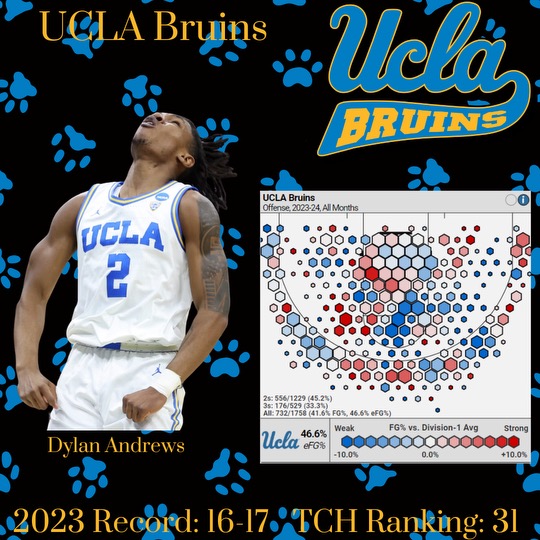
Here’s where each of our analysts have the Bruins ranked:
| Steven | Maxwell | Kam | Cody |
| 39 | 32 | 18 | 32 |
UCLA Men’s Basketball: 2022-2023 Season Overview and Legacy of Mick Cronin
Mick Cronin’s Impact Mick Cronin’s tenure as head coach of UCLA has been marked by consistent success and an emphasis on a defensive mindset. After building a formidable reputation during his time at Cincinnati, where his teams were known for toughness and defensive intensity, Cronin brought those same principles to UCLA. Since his arrival in 2019, Cronin has led the Bruins back into the national spotlight, culminating in a 2021 Final Four appearance. Entering the 2022-2023 season, Cronin’s career winning percentage stood at 69.5%, with over 450 career wins, making him one of the most successful active coaches in college basketball.
Under Cronin, UCLA’s identity has revolved around defensive tenacity, precise offensive execution, and an ability to develop and integrate talent. With three straight NCAA Tournament appearances, including a 2022 Sweet Sixteen run, Cronin has revitalized the storied UCLA program, aiming to build on the legendary legacy left by John Wooden. As the 2022-2023 season approached, expectations were sky-high, with the Bruins looking to capitalize on a mix of experienced players and exciting new talent.
2022-2023 Season Recap Coming off a strong 2021-2022 campaign, UCLA entered the 2022-2023 season with championship aspirations. The team returned 54% of their minutes from the previous year, including key contributors like Jaime Jaquez Jr., Tyger Campbell, and Jaylen Clark. Ranked in the top 10 preseason polls, the Bruins were favorites to win the Pac-12 and make a deep NCAA tournament run. The Bruins began the season with an impressive 11-2 record in non-conference play, highlighted by wins over Kentucky and Maryland. UCLA then surged through Pac-12 competition, finishing the regular season 27-4 and claiming the Pac-12 regular season title. A hallmark of their season was a 14-game winning streak that spanned from January to March, showcasing their dominance over the conference. However, injuries took a toll. Key defensive standout Jaylen Clark suffered a season-ending achilles injury late in the regular season, which proved to be a significant blow to their championship hopes. Despite the setback, the Bruins finished strong and entered the Pac-12 tournament as the No. 1 seed, reaching the final before narrowly losing to Arizona.
In the NCAA Tournament, UCLA was awarded a No. 2 seed. They advanced past the first two rounds, defeating UNC Asheville and Northwestern. However, their tournament journey came to an end in a heartbreaking Sweet Sixteen loss to Gonzaga, with a buzzer-beating three-pointer sealing their fate. UCLA finished the season with an impressive 31-6 record, solidifying their status as one of the nation’s top programs under Cronin.
Offensive Philosophy: UCLA’s offense during the 2022-2023 season was centered around precision and balance, led by veteran point guard Tyger Campbell and versatile forward Jaime Jaquez Jr. Jaquez, who earned Pac-12 Player of the Year honors, was the focal point of the offense, averaging 17.8 points and 8.2 rebounds per game. His ability to score both inside and outside, coupled with Campbell’s playmaking (13.4 points and 5.2 assists per game), made the Bruins a well-rounded offensive team. The Bruins were efficient, shooting 46% from the field (85th nationally), and averaged 74.1 points per game. Although not the fastest-paced team, UCLA’s offensive execution was methodical, often relying on half-court sets and strong ball movement, leading to an assist rate of 14.5 per game, ranking 76th nationally.
Defensive Philosophy: Mick Cronin’s defensive philosophy has always been the backbone of his teams, and the 2022-2023 Bruins were no different. Ranked 6th in the nation in defensive efficiency, UCLA excelled at forcing turnovers and locking down opposing offenses. Their commitment to switching defenses and aggressive man-to-man schemes disrupted opponents, with the Bruins allowing just 60.7 points per game (7th in the nation). Jaylen Clark, before his injury, was a key cog in UCLA’s defensive machine, leading the team with 2.6 steals per game and being named the Pac-12 Defensive Player of the Year. With Clark sidelined, Jaime Jaquez Jr. and senior David Singleton stepped up defensively. The Bruins held opponents to 41.2% shooting and were 14th nationally in opponent effective field goal percentage.
Key Players:
Jaime Jaquez Jr.: The heart and soul of the team, Jaquez led the Bruins in both scoring and rebounding, earning 1st Team All-American honors. His leadership, clutch performances, and two-way ability made him one of the best players in college basketball. Tyger Campbell: The veteran floor general, Campbell’s steadiness and poise were instrumental in orchestrating UCLA’s offense. He played a key role in maintaining the team’s tempo and facilitating plays. Jaylen Clark: Clark’s defensive prowess earned him national recognition before his Achilles injury, and his absence was felt as the team navigated postseason play. He also contributed 13 points per game on offense. Amari Bailey: The talented freshman provided a spark in key moments, averaging 11.2 points per game and showcasing his athleticism and scoring potential. Bailey’s contributions became more significant after Clark’s injury.
2023-2024: Rebuilding and Reloading Looking ahead to the 2023-2024 season, UCLA faces both excitement and uncertainty. With Jaquez, Campbell, and Singleton graduating, the Bruins will rely heavily on young talent and incoming recruits. Dylan Andrews is expected to take a leading role, while rising sophomore Adem Bona will anchor the frontcourt. The Bruins also welcomed a top-10 recruiting class, headlined by 5-star guard Sebastian Mack and 4-star forward Devin Williams, plus a strong international class including 7’3 big man from Spain Aday Mara, versatile point forward from Turkey Berke Buyuktuncel and crafty guard from Slovenia Jan VIde. UCLA, ranked in the top 20 in preseason polls, was again expected to contend for the Pac-12 title and make another deep run in the NCAA Tournament.
The Bruins started the season with a solid 10-3 record in non-conference play, securing wins over tough opponents like Villanova and Illinois. As they entered Pac-12 competition, UCLA struggled with some early inconsistency but soon found their stride, finishing the regular season with a 23-8 overall record and 15-5 in conference play, which earned them the 2nd seed in the Pac-12 tournament.
One of the key turning points in the season was the emergence of freshman guard Sebastian Mack, whose scoring prowess helped the Bruins fill the offensive void left by their veterans. Adem Bona also developed into one of the best defensive anchors in the country, making UCLA formidable in the paint. However, the Bruins faced several injuries throughout the season, which disrupted their rhythm at times, especially as the postseason approached.
In the Pac-12 tournament, UCLA advanced to the semifinals but fell to a surging Oregon team in a hard-fought contest. The Bruins received a No. 5 seed in the NCAA Tournament, where they advanced past the first round with a convincing win over VCU. However, in the second round, they faced a red-hot Texas team and were eliminated in a tight, back-and-forth game that ended in a 76-72 loss. UCLA closed the season with a 25-10 record, continuing their streak of tournament appearances under Cronin.
Offensive Philosophy The 2023-2024 Bruins relied on balanced scoring and efficient shot selection, driven by a mix of young and veteran talent. Dylan Andrews, who averaged 12.9 points per game, became the go-to scorer, while freshman Sebastian Mack added 12.1 points per game with his aggressive attacking style. UCLA’s offense was deliberate, focusing on half-court sets and ball movement, which contributed to their 41.9 % shooting from the field (312th nationally).
The team wasn’t known for its three-point shooting, ranking in the lower half nationally in attempts, but they excelled inside the arc with Bona providing a consistent post presence and offensive rebounding. UCLA averaged 66 points per game ranking 337th nationally, prioritizing shot efficiency and defensive transition over pushing the pace.
Defensive Philosophy Mick Cronin’s defensive system remained the cornerstone of UCLA’s identity in 2023-2024. The Bruins ranked 19h in the nation in defensive efficiency, anchored by Adem Bona, who averaged 1.8 blocks per game and was a force around the rim. UCLA’s man-to-man defense was relentless, with players like Mack and Andrews applying perimeter pressure while Bona dominated the paint.
The Bruins allowed just 65.5 points per game (19th nationally), regularly forcing opponents into tough, contested shots. Their defense thrived on limiting opponents’ from converting with there smothering defense. Opponents shot only 42.4% against UCLA, and the Bruins excelled at creating turnovers, averaging 5.5 steals per game.
Key Players
- Lazar Stefanovic: The Junior forward emerged as the Bruins’ outside scoring threat, averaging 11.5 points and 6.1 rebounds per game. He was lethal from distance shooting 39% from deep on almost 5 attempts per game.
- Adem Bona: Bona was a dominant presence on both ends of the court, averaging 12.4 points, 5.9 rebounds, and 1.8 blocks per game. His shot-blocking and rebounding anchored UCLA’s defense.
- Sebastian Mack: The talented freshman provided an immediate impact, averaging 12.1 points and 3.6 assists per game. His scoring bursts and defensive effort were crucial to the Bruins’ success.
- Dylan Andrews: The sophomore guard took on a larger role, contributing 12.9 points per game and providing steady playmaking in the absence of Campbell.
Looking Ahead: The 2024-2025 Season and Beyond
As the UCLA Bruins prepare for the 2024-2025 season, they aim to build on the success of previous years while navigating key departures. Under Mick Cronin, the Bruins have firmly established themselves as one of the nation’s elite programs, consistently contending for Pac-12 titles and making deep NCAA tournament runs. However, the loss of key player Adem Bona presents opportunities for new faces to step up.
Key Returners and New Leadership
UCLA returns a core group of players expected to take on larger roles. Rising sophomore Sebastian Mack, who had an impressive freshman campaign, will likely become the offensive leader. His scoring ability, particularly from the perimeter, will be crucial for the Bruins’ success. Joining him in the backcourt is Dylan Andrews, who will look to build on his solid sophomore campaign, forming a talented and experienced duo.
Another key returner is center Aday Mara, who will step into a larger role to fill the void left by Bona’s departure. After averaging just 9.1 minutes last season, Mara will look to substantiate his presence in the frontcourt. The versatile Lazar Stefanovic, known for his perimeter shooting and all-around play, will also return and be expected to build on his strong foundation from last year.
Recruiting Class and Newcomers
UCLA’s 2024 recruiting class brings a fresh wave of talent to Westwood. Leading the class is 5-star guard Trent Perry, a top-30 recruit nationally and one of the nation’s best shooters. Perry is expected to provide a spark off the bench, adding depth to the already strong backcourt. Eric Freeney, the nation’s 67th-ranked prospect, will also join the backcourt, although his role may evolve as the season progresses and he develops his skills. Both players will be names to watch toward the end of the season and into next year.
Transfer Portal Success
The Bruins found exceptional success in the transfer portal during the offseason, though they also had notable losses. Key players like Jan Vide (Loyola Marymount), Berke Buyuktuncel (Nebraska), and Will McClendon (San Jose State) departed, making room for several talented transfers.
The Bruins bolstered their frontcourt with the additions of versatile big man William Kyle III (South Dakota State) and Tyler Bilodeau (Oregon State). On the wing, transfers like Kobe Johnson (USC) and Eric Dailey Jr. (Oklahoma State) will add depth, while Dominick Harris (Loyola Marymount) and Skyy Clark (Louisville) strengthen the guard rotation. This newly constructed roster, combining returning players, talented transfers, and young prospects, makes UCLA one of the most exciting teams to watch heading into the Big Ten this season.
Season Expectations and Big Ten Excitement
As UCLA enters the 2024-2025 season, they are once again expected to contend for the top spot in the Big Ten. However, the competition will be tougher than ever, with programs like Purdue and Michigan State presenting formidable challenges. UCLA’s blend of experience and youthful talent puts them in a strong position to compete for the conference title. If their newcomers, especially the transfers, make an immediate impact, the Bruins have the potential to secure another high seed in the NCAA Tournament.
With Mick Cronin’s emphasis on defense and discipline, the Bruins will aim to bounce back and return to the NCAA tournament after a challenging previous season. They return 59.2% of their minutes and 67.4% of their scoring from last year, providing a solid foundation to build upon.
As the 2024-2025 season unfolds, all eyes will be on the backcourt and how the team’s young talent develops under Cronin’s system. The combination of a top recruiting class, key transfers, and returning experience positions the Bruins for another exciting season, with aspirations of adding to the program’s illustrious legacy.


 The Center Hub
Leave a comment