
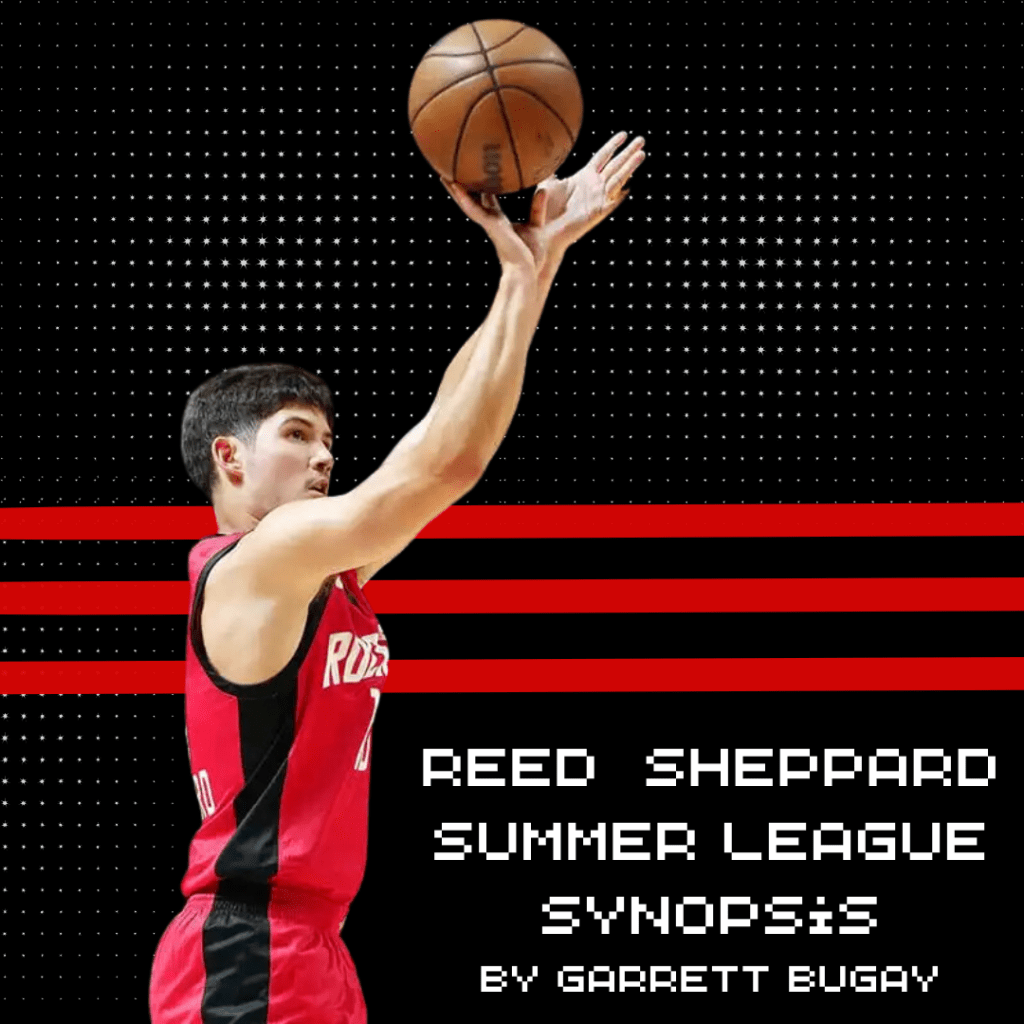
With the 3rd pick of the 2024 NBA Draft, the Houston Rockets selected Reed Sheppard. He had what many consider the most impressive Summer League performance of any prospect in the rookie class. He displayed a varied skill set and showcased all-star potential. Before we go any further, it should be noted that the Summer League is SEVERAL tiers below the quality of an NBA regular season game, let alone an NBA Finals contest. So take his performances and this analysis with the most enormous grain of salt you can fathom. Let’s just have some fun breaking down what he put on show and what it COULD mean for his NBA future.
Sheppard is listed at 6’3”, but even that seems generous. He will likely have to be a point guard at that size to maximize his potential. Like previous Kentucky star guards before him, Reed ended up in an off-ball role under John Calipari. He handled that role exceptionally well, mainly due to his insane shooting splits (53/52/83). But despite the impressive college production, Sheppard had much to prove as a lead initiator entering his Summer League stint. People rightfully questioned whether he had the dribbling or passing ability to warrant having the ball in his hands. We’ll start by breaking down his handle.
Sheppard utilizes three dribble moves most frequently. The right-to-left crossover, the left-to-right crossover, and a hesitation. In his very first Summer League game, he hit Bronny James with a nasty left-to-right cross that generated a wide-open corner three:
His crossover is very compact, low to the ground, and he tends to use it when he has a head of steam and the defender is backpedaling:
I watched all four Summer League games Sheppard played in their entirety, including two in person! He rarely had his crossover disrupted, perhaps in part because he uses it just infrequently enough to surprise defenders. He also doesn’t opt to utilize it if the defender is really pressuring up.
The hesitation move Sheppard implements is also quite effective. He likes to use it to lull the opposition to sleep, abruptly changing speeds:
He is capable of using his go-to moves in combination. Here, he uses a right-to-left cross to reject the screen, then uses a hesitation to gain a step on the screener defender (Sarr). The pass ends up being off the mark, but he bends the defense, and that’s the primary thing teams are looking for from a young guard:
Sheppard had 19 turnovers in his four games. That’s a concern, but many young guards have the same struggles early in their careers. It’s hard to prepare for the pressure that NBA-level athletes can apply. In his final game in Vegas, the Timberwolves really got into him and made him uncomfortable:
His handle is loose at times, and that most assuredly is something he’s going to have to work on. But given how much the Rockets asked of him from a usage standpoint and how calm and assured he appeared running the show, they must be really pleased. His pick-and-roll craft is beyond his years. Here, he runs his defender into a “Varejao screen” to get into the paint:
He also uses tricks like a push dribble to evade pesky “digs” from help defenders:
We probably won’t know for a few years if he has the chops to be a primary initiator, but the early signs are promising.
The next critical skill for a guard in the NBA is passing. Both of Reed’s parents were college players, and the understanding and intuition of the game is evident. This translates to his passing. He throws every type of pass: one-handers, hit-ahead, skips, pocket passes, lobs, and dump-offs. He’s consistently making the right reads, whether that’s finding a cutter along the baseline or hitting the shooter in the corner:
He’s capable of manipulation with his passing as well. He knows how to use the threat of shot and pass fakes to create openings to fit in passes that otherwise wouldn’t be possible:
The biggest issue with his passing mainly concerns his size or lack thereof. He struggles to pass over the top of the defense, often resorting to floaty passes that get picked off, deflected, or allow the defense to recover:
That last one probably doesn’t seem like that big of a deal, but at the highest levels, that extra loop on a skip pass can make the difference between a teammate getting their shot off versus getting their shot sent into the fourth row.
If you were on the Reed Sheppard bandwagon heading into the draft (like I was), the jumper was the primary reason. And he did nothing to dispel the notion that he’s as pure of a shooter as they come. One comparison I like for Sheppard is a mid-to-late career, Chris Paul. They both have great hands (which we’ll discuss in a bit), and they both have a silky smooth pull-up jumper going right:
(Please don’t come into my mentions saying I stated he’ll be as good as CP3. I’m just saying they have similar games, and a ceiling outcome for Sheppard might be in the ballpark of a 32-36-year-old Paul.)
Reed doesn’t seem as comfortable pulling up and going left, but he is absolutely still a threat going in that direction. Note the nasty in-and-out dribble he pulls out in this clip:
He mostly opted for threes when shooting going left but also showcased a lefty pull-up that might best be described as a leaner:
Given he’s on a roster with other ball handlers such as Fred VanVleet, Amen Thompson, and Jalen Green, Sheppard might primarily play off-ball as a rookie. His shooting acumen will suit him well in that type of role. He knows when to lift or drift to optimize the spacing for his teammates, and he has the range to spot up several feet beyond the NBA three-point line:
We didn’t see much of it in Summer League, given he was the primary initiator, but his shooting versatility will make him a dangerous off-ball shot creator. Here he is coming off a pin-down and flowing from the catch into his reliable righty pull-up:
If he is an off-ball player as a rookie, he’ll need to attack off the catch against a rotating defense. That includes driving against a closeout, making the extra pass, and finishing on drives. One skill he should be looking to add to his repertoire is the side-step three. In this play, he makes himself available on the right wing in transition, then, after an effective shot fake, opts to take a dribble towards the rim. He should be looking to take a side-step three, moving left away from the fly-by contest. The play still ends up in an open look for a teammate, but Sheppard is likely going to be the best shooter on the floor for his team, so he should be seeking to maximize his volume of three-point attempts:
When he drives into traffic, he often opts for tough floaters. It’s good he has a floater in his bag, and he did make a few, but most of them don’t feel like high percentage looks:
He makes it more challenging by jumping off the right foot to execute the push shot. Perhaps he’s doing that to get the shot off before an incoming contest, but it adds to the degree of difficulty. He has similar struggles when it comes to his finishing. We already discussed his lack of size, and while I think he’s an underrated athlete, he’s not rising over shot blockers and putting them on a poster. He has to be crafty to score at the basket:
Those plays are good examples of when he SHOULD jump off the right foot for a right-hand finish. It’s good to know he has that in his toolbag to get to the rim faster and elude rim protectors. When he can’t beat the help defender to the spot, he often throws up an extremely close-range floater or even opts for a jump shot. He should be slowing down, playing on two feet, and utilizing step-throughs and reverse pivots in these situations:
Any small guard would be wise to watch Jalen Brunson’s film to learn the intricacies of footwork and how to operate in tight areas. At 20 years of age, Sheppard’s offensive arsenal is already impressive, and fine-tuning his footwork and shot selection will go a long way toward making him a devastating offensive player.
Now, let’s get into the defensive tape. Like the shooting on the offensive end, Sheppard had one overwhelmingly positive defensive attribute: his propensity for steals/blocks (also known as stocks). In less than 29 minutes per game at Kentucky, Sheppard averaged 2.5 steals and 0.7 blocks. If you aren’t convinced about his quick-twitch hands just from his lone college season stats, he also averaged four steals throughout his high school career and put up 16 stocks in the four Summer League contests (also 4 per game). He gets them in a variety of ways, strips as the opposition player is bringing the ball into their shooting pocket, reading the passing lanes, and poking the ball away from behind:
In their game against Washington, Sheppard stifled two fast breaks and had a pick-six in an 87-second span at the start of the 3rd quarter. The dude is an absolute menace:
Clearly, he has a knack for getting his hands on the ball. Nate Duncan and Danny Leroux of the Dunc’d On podcast have noted that this skill makes him a much more viable one-on-one defender than guys like Andrew Nembhard, who got torched by the aforementioned Brunson. The reason is that offensive players want to feel comfortable getting to their spot and getting their shot off. It doesn’t matter how well they contest the shot if the defender provides no real threat to impede the attempt. Players like Brunson or Durant will hardly even know the defenders there.
Trust me, players are going to be aware of Sheppard’s presence. This isn’t to suggest he’s making an all-defensive team or that he’ll never get scored on (he is only 6’1” despite what I said he was listed at earlier). At a minimum, players will know they can’t be lazy with the ball and that he’ll be trying to take it from them. That alone probably keeps Sheppard from being in the bottom 20% of defenders. He also has an excellent veteran to learn from in teammate Fred VanVleet, who has excelled defensively as a more diminutive guard.
For Reed to become an average to above-average defensive player, he must clean some things up. The stocks are pleasant, but some gambles didn’t pay off:
He will have to find the right balance of being a defensive playmaker without taking unnecessary risks – – something VanVleet has mastered. Another byproduct of going for steals and blocks is if you misjudge or mistime the attempt, it usually leads to fouls. Sheppard had six fouls in one game and 4 in another. Sometimes, just being solid and forcing a tough shot is the best option:
I mentioned earlier that having parents who played basketball at a high level makes a difference in Reed’s “feel” for passing. That also applies to his defensive awareness. Help-and-recover is one of the pillars of defense. Recognizing that someone other than your assignment is a more significant threat means mitigating said threat and then recovering back to your man. Sheppard showed good instincts on numerous occasions:
I had Reed Sheppard number 1 on my 2024 Draft Board (I also traded Jalen Duren straight up for him in my Dynasty Fantasy Basketball League). He did nothing in the Summer League, which swayed me from being high on him as a prospect. The shooting is real. The defensive playmaking is real. The ball handling and passing chops are solid, with room for growth. The processing speed seems above average for his age. He has all-star potential, and if everything hits, he might end up in one or two All-NBA conversations by the time his career is through. The Rockets already had a highly enticing young core before Sheppard arrived, and now they might just have the best young core in the entire NBA.

 The Center Hub
Leave a reply to Basketball Intelligence For 8/24/24 – Undeniable Proof That You Need usa movie Cancel reply