
Intro
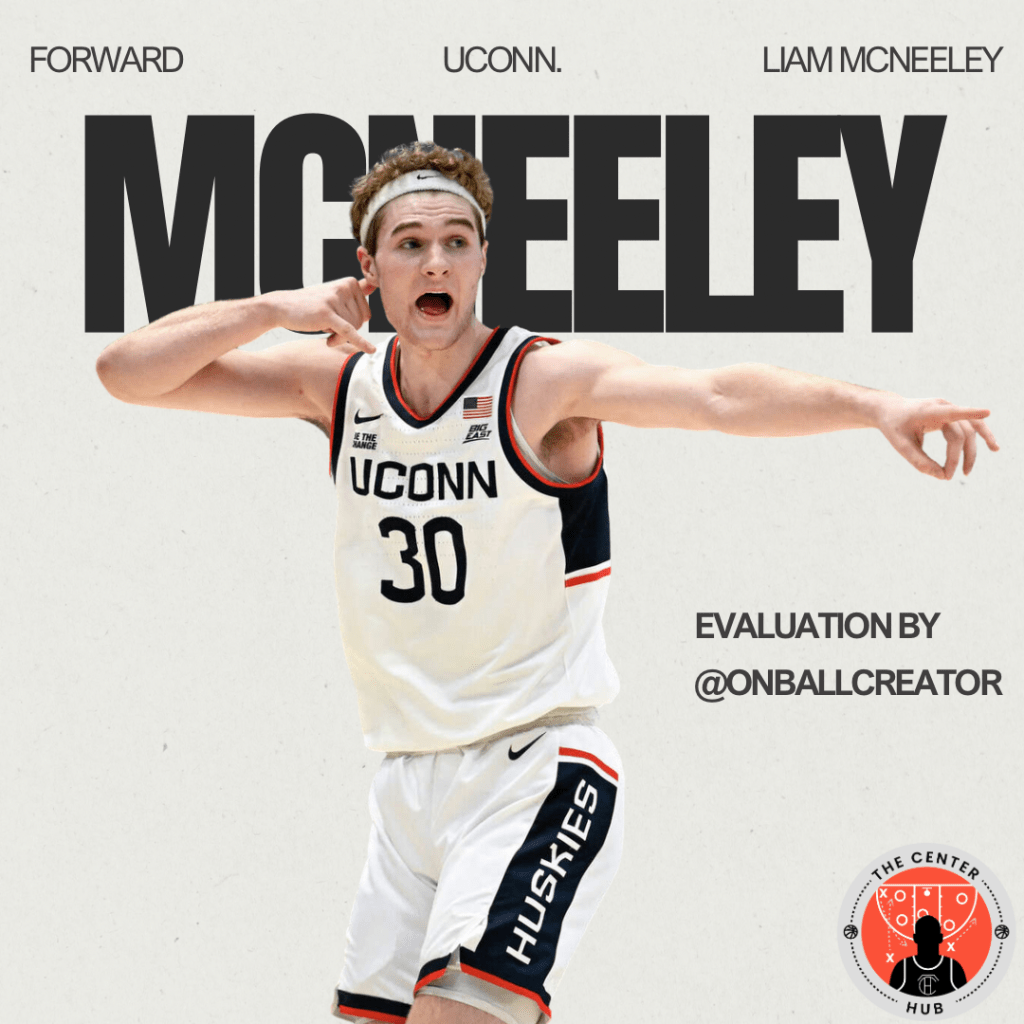
Liam McNeeley seems like a divisive prospect in NBA draft circles. Some people (and media outlets) see him as a late lottery pick. Meanwhile, there are others who wouldn’t take him in the 1st round and/or are strongly against their favorite team drafting him.
McNeeley’s case in the lottery is that he’s a tall wing shooter with good feel and connective passing. He can also put the ball on the floor a bit, and was a top-10 recruit coming out of high school.
The case against McNeeley as a first-round pick is that he’s subpar in terms of athleticism and defense. The main selling point is supposed to be his shooting, but he had a low 3FG% and low TS% this season.
I sit somewhere in the middle. I do think he’s a 1st round caliber prospect, but taking him in the lottery is a tad rich for my blood. I think somewhere in the 15-25 range is about right for where UConn’s sharpshooting wing should go.
Let’s Look at Some Data
Here’s a chart that includes historical data. McNeeley is listed here along with 15 other recent prospects who all fit the “tall wing shooter with good feel but suspect athleticism/defense” category to varying degrees.
The chart contains each player’s stats during their pre-draft season. Ingles went undrafted in 2009, but I used his 2009-2010 stats—those are the first seasons that RealGM has any stats for him. He didn’t play in the NBA until the 2014-2015 season anyway, so 2009-2010 was a pre-NBA season for him.
Also, I put the highest figure in green and the lowest figure in red for each category.

Takeaways From the Chart
First off, let’s address the elephant in the room. Of the 16 players on the chart, McNeeley is the lowest (by far) in 3 FG% and TS%. It’s a tall wing shooter archetype, yet McNeeley can’t shoot?
Not necessarily.
Let’s look at the context and peel back the onion a bit.
First, we notice that while McNeeley is lowest in 3 FG% and TS%, he’s highest in usage %. Well, logic tells us that the higher the usage, the harder it is to have really high efficiency (TS%, 3 FG%). And the lower your usage is, the easier it is to have high efficiency (TS%, 3 FG%).
Not only was McNeeley’s usage pretty high this season, but he was UConn’s number 1 option on offense. He was 1st on the team in usage and 1st on the team in FGA/100 possessions. That will also drive efficiency down, being the focal point of the opposing team’s defensive gameplan, getting the opposing team’s best defender on you.
Plus, this role as the number one option is definitely not something McNeeley was used to. The previous season at Montverde Academy, he was on a stacked team (including Cooper Flagg, Derik Queen, and Asa Newell) that went undefeated, winning the high school basketball national championship. On that team, he was the third/fourth option, playing more of a supporting role, mostly playing off-ball.
McNeeley also got hurt this season, which negatively impacted his numbers. This tweet touches on how much better he shot the basketball before his ankle injury, while also touching on how well he shot the ball in a lower usage role pre-NCAA:
Here’s a tweet which shows some film and data, illustrating how good of a shooter McNeeley was in high school:
Getting back to the chart, I’d also like to point out that while McNeeley is low in TS% and 3FG%, his 3PA volume is solid—he’s just a hair below the group average in that category despite being the fourth youngest player on the list.
McNeeley is also 6th out of 16 players in FT% – well above the group average in that category. Out of the 7 players who were under the age of 21 on draft night, McNeeley had the highest FT% among them.
I’d also add that while these guys are all tall wing shooters with suspect defense/athleticism, versatility is the name of the game in the modern NBA. The more things you can do well in terms of driving, passing, rebounding, etc., the more valuable you are. McNeeley grades out well in all 3 of those things. In terms of driving (FTr), he’s 1st out of 16 players. Regarding passing (assist%), he’s just a hair below the group average. Out of the 7 players who were under 21 when drafted, he’s 3rd in assist%.
McNeeley is above average compared to the group in TRB% as well. 6 out of the 16 players had a TRB% of 10 or higher, and McNeeley was 1 of them.
Overall, these are good numbers for McNeeley, especially given his age. Out of the 16 players in the archetype, he was the fourth youngest in terms of draft age. Again, he had the highest usage. All of these factors into the low 3 FG% and TS% this season.
If all he could do were shoot, I’d be more concerned about the low 3 FG% and TS%. But that’s not the case. He’s an underrated driver, a good passer, and a decent rebounder.
As for the shooting, between his age, high usage, ankle injury this season, solid 3PA volume, and crazy high FT%, I am pretty confident he will shoot the ball well in the NBA.
Now, let’s look at some more film.
Shooting
A shooter always becomes more valuable if they can hit shots off movement, rather than being limited to stand-still jumpers. So it’s encouraging that McNeeley has shown the ability as a movement shooter, as we see here:
Passing
McNeeley is a very good connective passer. He can pass off a live dribble. He can fit passes into tight windows, etc.
Driving
McNeeley is an underrated driver. He’s not much of an ISO guy but more of a guy who can attack closeouts, drive when he has a screen set for him, and be a threat to drive when he gets the ball on the move.
Also, his high FTr (Free Throw Rate) indicates that he embraces contact and physicality. So when he drives, if there’s contact, he can still make a play and score or get himself to the FT line.
Rebounding
Just like with the high FTr, the solid TRB% of over 11 indicates McNeeley is willing to get into the paint, mix it up, do the dirty work-the little things—to help his team win. It shows that he’s got some toughness to him and is more than just a shooter.
Intangibles
When it comes to projecting how these prospects will turn out at the NBA level, more than just film and stats matter. Intangibles also matter.
One intangible I look for is body language. Some players’ body language sends the message that they don’t really care about the game’s outcome. They look disinterested or indifferent.
Meanwhile, other players’ body language sends the message that they have a passion for the game – a true competitive drive – they get fired up. That’s what McNeeley has, and it’s pretty clear when watching him play – at UConn and for Montverde.
Confidence is another intangible you often see in players who shine in the NBA, and McNeeley has plenty of that too.
I’d also add that McNeeley played for arguably the best high school coach in America at Montverde (Kevin Boyle) and arguably the best college basketball coach on the planet right now at Connecticut (Dan Hurley). That should help increase his odds of success at the next level.
Weaknesses
Defense and athleticism are the main ones for McNeeley. While limitations in those areas likely do put a cap on his ceiling as a player, those same limitations are there for basically all of the other players listed on the chart at the beginning of this article. Yet most of those players are good rotation players in the league. One of them (Risacher) was the number 1 pick in last year’s draft, and another (Hauser) just won an NBA title last year as a key player off the bench.
I’d also add that defense (and strength, which is a limitation for McNeeley) are two of the more common areas we see players improve in after getting to the NBA, especially players who are only 19 years old when drafted.
Role Projection
This is pretty straightforward. McNeeley projects fairly similarly to guys like Joe Ingles, Luke Kennard, and Kevin Huerter. He gives his team some value with shooting from distance while also driving closeouts, giving you some good connective passing as well, grabbing some boards here and there, and hopefully being serviceable enough on defense that he’s not too much of a liability on that end.
Conclusion
The hope is that he’s a solid wing off the bench (like guys like Kispert, Hauser, and Kennard have been) with the potential (if his development comes along well enough and he lands on the right NBA team) to be a solid 4th/5th starter.
That would be worth a top 20 pick – maybe even a pick in the top 15.
I have him ranked at 22 on my big board at the moment. Mainly because the defense does scare me a bit, I’d like the shooting consistency to be better, and some of the ball skills need improvement too. But he may end up a bit higher on my board (like in the 15-20 range) by the time draft night arrives. I don’t even think it’s that crazy if a team takes him in the 12-14 range.

 The Center Hub
Leave a comment