
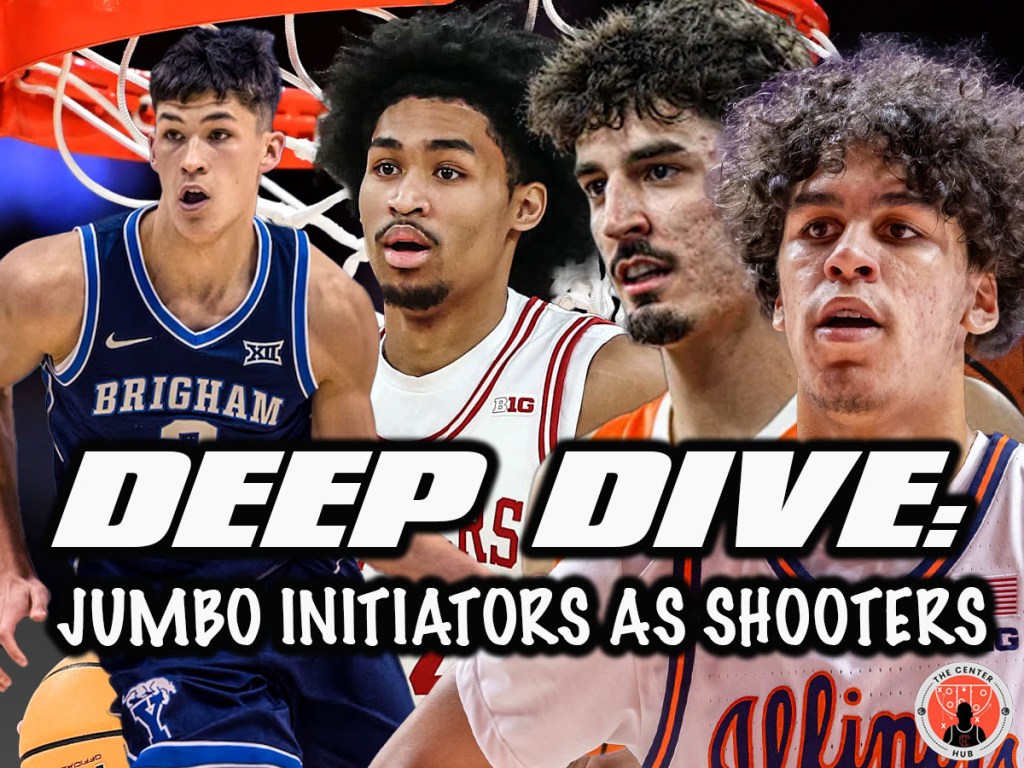
This is a follow-up to the shooting projection article I did earlier in the season. That other piece was more broad and touched on many different concepts, ideas, and research related to shooting projection. This one focuses on the shooting projection of “Jumbo Initiators.”
For the purpose of this article, I’ll loosely define jumbo initiators as players who are 6’6″ (in shoes) or taller. They’re guys who, prior to being drafted, brought the ball up the floor a decent amount, had a decent amount of possessions where they initiated the offense, ran some pick-n-roll, and were either the full-time PG for their team or played PG a decent amount.
The taller the prospect is and the more ball-handling, offense-initiating responsibility they carried as a prospect, the more they fall into this archetype.
From the 2025 draft class, the jumbo initiators we’ll mainly be focusing on for this article are Egor Demin, Will Riley, Dylan Harper, and Ben Saraf. Kasparas Jakucionis (measured 6’5.5″ in shoes) just missed the cut.
One of the reasons I wanted to write this piece is that I think these players (and jumbo initiators from previous draft classes like Stephon Castle, Anthony Black, and Scottie Barnes) have been unfairly criticized for their shooting.
The hypothesis I was testing is that with jumbo initiators, we can’t just look at their shooting numbers at face value. We must grade them on a curve because they typically have lower shooting numbers than other prospects. The more ball-handling and offense-initiating responsibility they had as prospects, the lower their shooting numbers would likely be.
Other factors include age, competition level, and size. The younger the prospect, the lower their shooting numbers are likely to be. The higher the competition level, the lower their shooting numbers will likely be. And the taller they are, the lower their shooting numbers will likely be.
Alright, without any further ado, let’s take a look at the data, which includes each player’s stats during their pre-draft season. The prospects from the 2025 draft class are in bold:

The first thing I want to call out is what the averages turned out to be for this data set:
Average draft age: 19.6
Average usage %: 24.2
Average 3FG%: 31.0
Average 3PA / 40 Mins: 5.1
Average FT%: 71.3
Average draft slot: 10.7
So basically, if you’re a jumbo initiator prospect who’s 6’6″ or taller in shoes, you’re automatically a legit draft prospect. If you’re also 19.6 or under, that’s a plus. If you’re at 24.2 or higher usage, that’s a plus. If you’re at 31.0 or higher from 3, that’s a plus. If you’re at 5.1 or higher in terms of 3PA / 40 Mins, that’s a plus. And if you’re at 71.3 or higher in terms of FT%, that’s a plus.
The more of those boxes you check, the higher the odds you’ll be picked in the top 10.
Like with anything, there are exceptions. Let’s look at Jordan Hall. He was a bit older than 19.6. However, his usage, FT%, 3 FG%, and 3PA volume were all above average compared to the others in this data set. Plus, he was one of the tallest players on this list. So he should’ve been at least a lottery pick, right?
Well, not exactly.
As I touched on earlier, competition matters. Hall played in the A-10, a mid-major conference, so it’s a step down compared to the competition that most of these other guys played against. But what about the Thompson twins? They were basically the same age as Hall and also played against somewhat subpar competition in OTE.
Why were the Thompson twins top-5 picks and had good NBA careers, while Hall went undrafted and hasn’t made it in the league (so far)?
The short answer is athleticism. Hall was just not very quick, strong, or athletic. The Thompson twins are among the top 1% of athletes. There’s such a massive difference that it almost makes it silly to compare them.
Hall was a significantly better shooting prospect than the twins, though. But in addition to the vast difference in athleticism / physical tools, there’s also a significant difference on the defensive end, where the twins were much better. There’s also a major gap in ball handling, driving, and rim pressure. Hall had an FTr of 14.3, which is historically low, especially for a player with that kind of size. He also had a low BPM of 3.0 and a TS% below 50, numbers that are especially low considering he was facing weaker competition and was a sophomore rather than a freshman.
What is the lesson here regarding Hall? The numbers in the above chart are a piece of the puzzle—they’re not the entire puzzle or the entire evaluation. Other factors, like competition level, turnover percentage, BPM, TS%, FTr, etc., should also be considered.
The next thing I want to call out is Ben Simmons. As we can see from the chart, he was by far the worst shooting prospect on the list. While his 3 FG% was actually slightly above average within this group, the 3PA volume was so insanely low that the 3 FG% didn’t matter. Plus, the FT% was also very low. However, Simmons is also the tallest player on the list, which is what I want to point out here.
There seems to be a correlation where the taller players on the list – especially guys like Simmons, Demin, Banton, and Dieng (all international players, which may or may not be a coincidence) were among the poorest shooting prospects, while a lot of the better shooting prospects on the list were among the shorter ones on the list – guys like SGA, Lonzo Ball and Cade Cunningham – all closer to 6’6″. Harper (also 6’6″) also has some of the better shooting indicators among the data set.
To take it a step further, if we look at many of the recent initiator guard prospects who were the best shooters, most of them were shorter than 6’6″, such as Kyrie Irving, Darius Garland, Kemba Walker, Damian Lillard, Payton Pritchard, Bones Hyland, Trae Young, Jamal Murray, Tyrese Haliburton, etc.
This is why I think initiator guard prospects have to be graded on a curve when it comes to their shooting projection. The taller they are, the worse their shooting will probably be. Initiator guards who are 6’6″ (in shoes) and taller will probably have worse pre-draft shooting numbers than those who are under 6’6″.
That means we should have some leeway and not be too critical of initiator guards who are 6’6″ or taller when it comes to their shooting numbers. We should also not get too excited and not overrate smaller guards under 6’6″ who do have good shooting numbers.
From this research, as well as research I’ve done on shooting projections of various big man prospects, which I touched on here, the common theme is that the taller the prospect is, the worse their shooting numbers are likely to be. The shorter the prospect is, the better their shooting numbers are likely to be.
Also, while taller prospects are likely to be worse shooters before being drafted, they often develop into adequate shooters – it just may take some time and development after they’re drafted. Nikola Jokic, for example, did not shoot well as a pre-draft prospect (from 3 or from the FT line), but he ended up being a good shooter in the NBA – because taller guys often develop their shooter at a later age than 18/19. Or they might need to stay in college longer – Baylor Scheierman shot poorly as a freshman but ended up being an excellent shooter by his junior/senior year.
Additionally, taller prospects usually aren’t as good shooting-wise as shooter prospects who are under 6’6″, but taller prospects typically make up for their limited shooting in other areas. For example, taller players are usually better at guarding up the lineup. They’re typically better rebounders and better rim protectors—better at seeing over the top of the defense to read the defense, find the open man, and make plays. They’re also oftentimes better at driving to the basket and finishing at the rim than taller defenders.
All of this needs to be factored in, and these are all reasons why NBA teams often covet jumbo initiators.
Take Shaun Livingston, for example. He was a non-shooter (under 0.5 3PA / game in every season of his NBA career), yet he was still a good role player. He had a long NBA career and contributed to winning basketball. He played in five NBA finals and won two NBA titles. And he would’ve had an even better career if he hadn’t torn his ACL.
Stephon Castle wasn’t a good shooting prospect and wasn’t a great shooter as a rookie, yet he was still just awarded NBA Rookie of the Year:
Next, let’s take a closer look at the four jumbo initiators from this year’s draft class.
One thing we’ll examine is how their shooting numbers look if we expand the sample size. I like doing exercises like this because I think one mistake some draft evaluators make is putting too much weight on a one-season sample size. One season is a pretty small sample size. Expanding it can make a more accurate, thorough evaluation.
From tallest to shortest…
Will Riley
Looking at Riley’s numbers on the chart compared to the rest of the data set, one can see that he’s younger than the average draft age. He’s the 4th tallest on the list. Usage: he’s just a hair below the average. Shooting-wise, he’s just above the average in 3FG%, FT%, and 3PA / 40 Mins.
He’s a good prospect. There’s a lot to like. His assist % wasn’t crazy high, but his turnover % was very low, so that’s good. I think he’s worth a late lottery pick.
If we expand the sample size to include Illinois’s exhibition game vs. Ole Miss and the most recent 26 games pre-NCAA, we could find data for (2024 EYBL as well as 23-24 season HS games) in addition to the 24-25 season with Illinois so a 62 game sample size:
32.5% from 3 on 4.5 attempts per game, 75.2% FT
So, the 3 FG% is the same, slightly above average compared to our dataset. The 3PA volume is still good. Interestingly, by expanding the sample size and including pre-NCAA games, the FT% jumped significantly.
Riley was 72% at Illinois but was 78% FT pre-NCAA and 75% for a combined pre-NCAA + NCAA FT%. The higher pre-NCAA FT% gives some additional optimism for his shooting projection.
Also, for the 15 EYBL games I found data for in 2024, he shot just 28.3% from 3. But that’s not bad for a 6’8” initiator guard who was only 18 years old and had yet to step foot on a college campus.
I’m even less concerned about that EYBL 3 FG% when I watch the tape. Here’s some film of 1 of his EYBL games from the summer of 2024, before he decided to reclassify and enroll at Illinois. Just look at the degree of difficulty on these shots. Look at how many of these shots he’s having to self-create. And look at how much defensive attention he’s getting:
The shot-making and shot-creation ability and handle Riley shows in that EYBL tape is bananas – especially for a 6’8” initiator who’s only 18 years old. These clips are all from the same game, too – and I left out other plays from that game. Calling him a potential lottery pick should not be a hot take.
Egor Demin
I’m less bullish on Demin’s shooting projection. His 3 FG% and FT% were below average compared to the dataset. His usage is right about average compared to the dataset. But to be fair, he is one of the younger players on the list and one of the tallest.
Because he’s so young and so tall, we need to give Demin some leeway. Also, his 3PA volume is higher than the dataset’s average, which is also encouraging. On film, his shooting mechanics look pretty smooth – although it is kind of slow for Demin to rise up and release his shots. If he can speed it up a beat, that would help.
Expanding the sample size to include Demin’s freshman season at BYU + BYU’s exhibition game vs. Colorado Christian, + the 8 games during the 23-24 season they have data for on RealGM, we then have a 42-game sample size:
25% from 3 on 4.7 attempts per game, 70.5% FT
The volume is good, but not great. The 3 FG% and the FT% are both poor.
But again, I’m low on Demin’s shooting projection, but not that low. He’s really tall and very young. Tall players tend to develop their shooting later, and young players often develop their shooting later—especially if they already possess another outlier skill. In Demin’s case, it’s his feel/passing ability.
It might be a lazy comparison, but there are certainly some similarities between Demin and Josh Giddey. I can see an argument for Giddey being a better prospect. But I can’t see an argument for Giddey being a massively better prospect.
I wouldn’t take Demin in the top 10. I think somewhere in the 12-21 range is about right for where he should go in the 2025 draft.
Dylan Harper
Looking at the chart near the top of this article, Harper ranks 2nd out of 20 players in usage %, just a hair behind Cade Cunningham. He’s above average for this dataset in 3 FG%, FT%, and 3PA volume. He’s one of the younger prospects in the group as well. So, it’s pretty easy to be optimistic about his shooting potential.
Digging deeper, Harper’s shooting numbers this season look even better if we exclude the 6 games in January he played with the flu (which caused him to lose 15 lbs mid-season) and ankle injury.
This shows how much his shooting numbers dropped off during these 6 games in January:
24-25 season, all 29 games: 33% from 3 on 5.1 3PA/game, 75% FT
6 games in January: 24% from 3 on 4.1 3PA/game, 54.5% FT
23 games, excluding January: 35.2% from 3 on 5.4 3PA/game, 78% FT
Harper also shot 36.8% from 3 on catch and shoot 3’s this season at Rutgers. Additionally, he posted 1.02 Unassisted 3 PM / 40 Mins, which was 3rd among high major freshmen this season, only trailing Tahaad Pettiford and Kasparas Jakucionis. Harper is the only 1 of those 3 guards who is 6’6” or taller.
Harper did shoot poorly (30.9%) on far 2s this season, but there’s enough positive stuff in his shooting profile to be optimistic.
Lastly, to my knowledge, Harper is the only prospect in the 2025 draft class who’s hit not 1 but 2 game-winning jump shots recently – as we see here:
Ben Saraf
If we expand the sample size and include the exhibition game Ratiopharm ULM played vs. the Portland Trailblazers (literally an NBA team, so perfect competition) and 10 games representing Israel dating back to last summer, in addition to his 24-25 season with ULM – a 55 game sample:
32.8% from 3 on 2.7 attempts per game, 73.0% FT
Those are pretty encouraging numbers. The 32.8% from 3 is significantly better than the 28.7% he is shooting this season for Ratiopharm ULM. So that shows you that by expanding the sample size to include some other recent games he’s played, he’s actually a better shooter than the numbers indicate if we only looked at this current season with ULM.
The FT% is the same, so he seems to be consistently around that 73% mark from the FT line – which is good since the average FT% for our jumbo initiator data set is 71.3%.
However, when we expand the sample size for Saraf, the volume is slightly low at 2.7 3PA / game. His 3PA volume this season at ULM is kind of low as well, at 3.9 3PA / 40 Mins, which is below our data set average of 5.1.
Due to the low volume, the 3 FG% and FT% numbers, which are decent but not great, and his shooting mechanics, which are also decent but not great (he kind of pulls the ball back and shoots it like a catapult, which isn’t the smoothest shot you’ll ever see and is a little bit slower since he pulls the ball back like that before shooting it), I’m not super optimistic about his shooting projection.
Also, his catch-and-shoot numbers from deep are solid. But on film, he doesn’t appear to be very comfortable or very effective pulling up off the dribble and shooting 3s.
However, the numbers aren’t that bad. He’s very young, and he’s a taller guard at 6’6”. Younger players often develop their shooting later, and taller guards often develop more advanced shooting later on. Plus, he’s a very good playmaker, a good driver, and has good handles, so he has other things he brings to the table—and the fact that these other skills are so advanced at such a young age means that he developed them first and will likely get better at his shooting later on.
So overall, I’m not too worried about Saraf’s shooting. But I’m also not projecting him to be a great shooter long-term. I think it’s possible he could eventually be a league-average shooter – especially off the catch.
Wrapping it Up
For all the reasons we’ve already explained in this article, I’m not too worried about the shooting for any jumbo initiators in this year’s draft class (Harper, Riley, Saraf, Demin).
If I had to rank them in terms of their shooting projection, it’d probably look something like this:
Dylan Harper
Will Riley
Gap
Ben Saraf
Egor Demin
The bottom line is, don’t just take a prospect’s shooting numbers at face value. Dig deeper and look at the context behind the numbers. Look at historical data to see how that prospect’s numbers compare to other recent prospects similar to them and also expand the sample size beyond just 1 season.
Thanks for reading!

 The Center Hub
Leave a comment