
We’re heading towards latter parts of January, so it means that the NBA draft is now just 6 months away.
The NBA regular season is halfway done now, college basketball is now approaching the second part of the season as well.
We saw some fantastic games last week, with Gonzaga getting knocked out twice in WCC against Oregon State and Santa Clara (at home!), which doesn’t happen very often. And the SEC delivered, as always.
Let’s dive into it.
No fouls allowed
Creighton’s Ryan Kalkbrenner is one of college basketball’s most dominant bigs. He has been for some time now.
He’s taken another step forward this year with his efficiency shooting (or, most of the time, dunking) the ball, and is now a competent three point shooter, albeit on a very low volume, as he pretty much only takes threes when left completely wide open, or as a trailer, with his man sinking deep in the paint.
Kalkbrenner’s offense would be pretty easy to project at the next level. Though he does a lot of posting-up well, he’s generally less impactful, less versatile player on offense than, say, Johni Broome. I think he could easily transition into a limited role on offense as a roller, rim-runner, cutter and off rebounder.
At least in college, Kalkbrenner brings most of his value defending the paint. He had a monster game against Providence on Tuesday with 6 blocks. His BLK%, standing at 8.3%, is good, but not anything too special for a 7’2” paint defender, but Kalkbrenner’s ability to defend vertically and avoid fouls is pretty darn incredible, as he consistently logs games with 0 fouls.
The problem with Kalkbrenner begins when he’s pulled away from the paint, which is something that NBA teams would surely be looking to exploit. His lateral quickness and agility are poor, and Kalkbrenner struggles to recover ground after losing a step or two initially even when possessing elite length.
I don’t see Kalkbrenner as a first round pick, tough I’ve seen some people mock him in the 20s. Despite that, 7’2” is an outlier length and is worth a swing, which is not to say that Kalkbrenner is simply tall. I do like Luke Kornet as a potential high end outcome for Kalkbrenner; their paths and statistical profiles are pretty similar, though Kornet, obviously, was a markedly better shooter in college. There’s surely a path for this type of player to make it stick in the NBA as a backup big who can play minutes in the regular season.
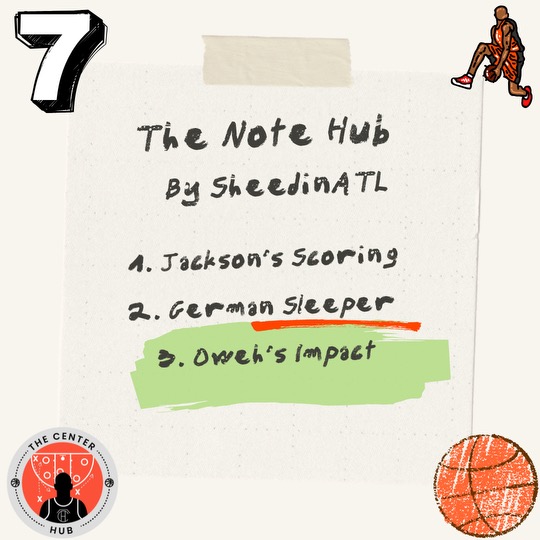
Jackson and his passing
North Carolina’s Ian Jackson has been balling recently. Ever since being inserted into the starting lineup around the turn of the year, Jackson has been putting up 20+ point games like it’s nothing.
Last week, he dropped 20 in a home win against Cal, playing as a tertiary guard alongside RJ Davis and Elliot Cadeau. Since the December 21st win against UCLA, Jackson posts 9.1 BPM on 65.2% TS, scoring under 20 only once, against SMU on January 7th.
This type of production puts Jackson back in the one-and-done conversations.
First and foremost, Jackson is a shotmaker, who’s heavy on iso play. Per Synergy, Jackson plays iso ball on 15.3% of his possessions, which is higher than the time he spends as P&R ball handler (14.8%). His iso volume ranks in the 90th percentile, and the production numbers have been good so far – 62.8% TS.
UNC’s fast pace of play allows Jackson to get out in transition a ton, where he’s very capable at controlling his pace and finishing around the rim. As you can see from this graphic by @mcfxz, Jackson’s rim profile slots in very nicely into high volume, high efficiency rim scorers, alongside guys such as Cooper Flagg or Jeremiah Fears.
The tricky part with Jackson is the question of who he is aside from the scoring. Defense is not his calling card – though he’s a capable vertical athlete attacking the rim and can cover a lot of ground with his athleticism, this does not translate to defensive numbers at all yet. UNC does play a super small backcourt. Within that system, POA defense is left to better defenders in Cadeau and Seth Trimble, while Jackson is mostly tasked guarding the corner shooter.
The poor assist numbers are even more concerning – in iso situations, Jackson is mostly looking to score; having a sub-10% AST number for a short guard that plays a lot with the ball in his hands is kind of a red flag for me, though this can at least partially be explained by his rather peculiar role as a guard playing on the wing, alongside two high assist men in Davis and Cadeau.
I’m still not sure over whether Jackson should declare or return. His stock is definitely trending up, but he won’t be a wing at the next level. Getting more reps as a lead guard would be a litmus test of his next level translatability.
German sleeper?
Oregon State’s home win against Gonzaga in overtime might have been the best college basketball game of the week.
The star of that game undoubtedly was the 6’9” forward from Germany, Michael Rataj, who hung 29 on the Zags, making a bunch of awesome plays down the stretch, including a left-handed finish on a drive against Graham Ike and two clutch threes in overtime to seal the win for the Beavers.
Rataj has been having somewhat of a breakout season in his junior year. He’s a two-way player with a very strong upper body for a 21 year old. Rataj’s breakout mostly comes from his ever-increasing influence on offense, with his usage going up from 18.9% to 29.2%.
A sizeable chunk of that offense is generated via post-ups, going to them on 17% of his attacks, while the efficiency ranks in the 95th percentile, per Synergy. He’s a mismatch for most wings in college basketball strength-wise, with good footwork, touch around the rim and passing ability also coming to his aid.
Rataj does possess a functional handle of the ball. Against Gonzaga, he showed some real nice flashes attacking bigger players on the perimeter off the dribble, but his handle mostly functions as a means to break off that initial layer of defense at the perimeter – when faced with help, Rataj does often resort to backing down his opponents.
He’s also a pretty unremarkable vertical athlete, which is something that often prevents him from going all the way to the basket. Despite that, Rataj is a very good rebounder for a wing player, his active hands, defensive awareness and timing, coupled with long arms, enable him to make steals and block shots at an above decent rate as well.
One to look out for.
Kentucky’s best prospect?
In their first season under head coach Mark Pope, Kentucky finds itself in a bit of an unusual situation. They’re obviously a very good basketball team, but there was no top3 ranked recruiting class waiting on the doorstep of Rupp Arena. Well, technically maybe there was, but they all left with John Calipari.
So, who’s Kentucky’s best NBA guy then? Are there any at all?!
On Saturday, forward Otega Oweh put out a statement with his performance in a loss against Alabama. On the season, Owen has been one of Kentucky’s best performers, posting a BPM of 7.8, second best on the Kentucky squad.
Oweh’s energy and toughness really shone through at both ends of the floor. He was relentless at pressuring the ball, going at the boards and looking to speed up the play every time he got a chance to do that, especially off defensive rebounds. Having great rim runners like Brandon Garrison helps him a ton two, with Oweh finding Garrison with a beautiful one handed pass in transition.
At 6’4”, he’s not a tallest player for a guard/wing type of prospect, but he does play taller than that because of his long arms and vertical athletic ability that allows him to dunk a lot of his rim shots, 25%, to be exact. In terms of dunking the ball, Oweh is a pretty clear leader in all of D1 among players 6’4” and shorter.
Oweh is definitely a player that’s worth keeping an eye on in the NBA draft context. Though he’s undersized as a wing and not a great shooter, he could still find his way in the league with his motor, feel and high level athleticism.
Heading to the draft?
St. John’s head coach Rick Pitino has seemingly let it slip that his junior forward RJ Luis intends to go pro after this season, something that has caught Luis himself by surprise, who after the Seton Hall game on Saturday told that he hasn’t thought about his future at all yet.
Luis hasn’t been featured on too many mock drafts, but his production in the Big East suggests that he could be a 2nd round guy.
He dropped 24 on a helpless Seton Hall team, in a game that looked pretty much done 10 minutes in. Interestingly enough, Luis did a lot of his damage from downtown, making season best 4 threes. On the season, Luis is just 28% on 6.7 attempts per 100 from three, so that’s clearly something he has to work on.
It’s hard to take a lot from such a one-sided game, but, besides his shooting, Luis did cause a lot of problems for the Pirates on the glass – his rebounding numbers have been good pretty much throughout his career in college
He’s an interesting two way player with some downhill ability. He doesn’t really need the ball in his hands too much to be effective, as Luis is On defense, Luis is a switchable wing defender who does get to show a lot of that versatility in Pitino’s switch-heavy defense, logging 2.9% STL and 2.2% BLK percentages on the season.

 The Center Hub
Leave a comment