
I think it’s important with NBA draft scouting that we form our own opinions and stick to our guns, rather than following along with the consensus.
Just because everyone is saying that Cooper Flagg is the best player in the 2025 draft class, doesn’t mean he is.
Consensus thought Markelle Fultz was no. 1 in 2017 and that Deandre Ayton was no. 1 in 2018. They were wrong.
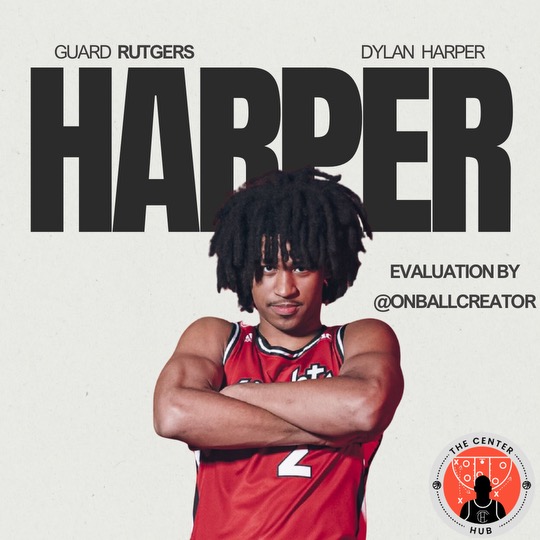
In this article, I will make a case for Dylan Harper as the best prospect in this draft.
Archetype Analysis
The main reason why I have Harper ranked over Flagg is archetype. Before going further, let’s take a look at a list of players who are roughly the top 36 players in the NBA currently:

As you can see, there are only three players on that list who are not elite on offense—Gobert, Adebayo, and Holmgren. 33 of the top 36 players in the league (91.6%) are elite on offense. By that, I mean they’re elite at getting buckets (scoring and/or playmaking).
This tells us that if we’re playing the odds and trying to draft a guy with a chance at being a legit franchise-altering star who could be a top 36 (or even top 20) player in the league, your odds are much better if you draft a guy with a higher probability of becoming an elite offensive player.
I don’t think it’s a hot take to say that Cooper Flagg (while he is a VERY good prospect) has some limitations on the offensive end. I think he’s a good offensive prospect – but not an elite one. I think Dylan Harper is an elite offensive prospect.
It’s well documented that there are some concerns about Flagg’s shooting ability, as well as his offensive “bag” and ability to score the basketball in the half-court off the dribble. I think Flagg projects to be average or just above average in each area. I have a hard time projecting him to be elite in any of them. On the other hand, Harper is a better driver, a better shooter, and better at setting up teammates with his passing.
Pick-and-roll and isolation are the two most common offensive play types in the modern NBA. Harper is very good at both – he’s better than Flagg at both.
Most of what I see from Flagg regarding shot creation on film is just straight-line drives. He is often just trying to bully his way to the hoop, which won’t work as well against bigger, better defenders in the NBA.
Oftentimes, Flagg catches it on the wing and either doesn’t even try to attack – or he makes one or two dribbles, is unable to create an advantage, and is forced to pass it back out to a teammate. Other times, he tries to do a basic crossover dribble move but is unable to get all the way to the rim & has to either pass it or try a floater in the lane. His bag is average at best, in my opinion, at least when it comes to projecting him as being a 1st/2nd option on an NBA team.
While Flagg does show good feel/instincts, I’m projecting that to be more of a connective piece offensively in the NBA. A ball mover—move it quickly to the open man to keep the offense flowing, crash the boards, score out of the dunker’s spot, maybe hit some spot-up 3s, attack the occasional closeout rather than be an actual offensive engine, which I see Harper being.
Flagg is only 17 years old, so the potential is there for him to end up being better and more polished as a scorer/creator. You never know. Anything is possible. But if I have the number 1 pick, I’d want more of a sure thing. Harper already has that stuff in his bag. He’s a shot creation savant, makes it look so darn easy, and is only 18.
Diving into the shooting a little bit. We’re still early in the NCAA season, but if we look at a 13-game sample for both Harper and Flagg (including early season NCAA games, preseason NCAA games, one intra-squad scrimmage for their college teams, Nike Hoop Summit, McDonald’s All-American Game, Jordan Brand Classic and late season games from last year’s high school season) here are their shooting numbers:
Dylan Harper: 35% from 3 on 6.1 attempts per game
Copper Flagg: 31% on 3.3 attempts per game
Harper’s 3 FG% is a fair amount higher on a much higher volume. And that’s also on a tougher shot diet for Harper since he is a guy who handles the ball a lot more than Flagg – more of those 3PA for Harper are off the dribble, self-created, and contested. More of Flagg’s 3PA are open catch-and-shoot looks.
Speaking of the Nike Hoop Summit, McDonald’s All-American Game, and Jordan Brand Classic are the three recent games that both Flagg and Harper played. So, while it’s a small sample size, and you don’t want to put too much emphasis on all-star (or showcase) games, I do think it’s worth noting how they played in those games:
Dylan Harper: 52.9% from 3 on 5.6 attempts per game, 53.3% FG, 35.2 points per 40 mins, 2.75 assist-to-turnover ratio
Copper Flagg: 25% from 3 on 2.6 attempts per game, 57.5% FG, 24.5 points per 40 mins, 1.6 assists to turnover ratio)
In the Jordan Brand Classic, Harper made a statement. He dropped 30 points (including a three right in Flagg’s eye) and was the best player on the floor:
It’s a small sample size, but Harper is scoring basketball better at the college level. Here are their scoring numbers so far this season:
Harper: 27.2 points per 40 mins on a 64.6 TS% and a FTr of 50.0
Flagg: 22.8 points per 40 mins on 53.3 TS% and a FTr of 36.5
Here’s how many times each player notched 20+ points in their first three NCAA games:
Dylan Harper: 3
KD: 3
Zion: 3
Cade Cunningham: 2
Trae Young: 2
Anthony Edwards: 2
Markelle Fultz: 2
Brandon Miller: 1
Steph: 1
Paolo: 1
Flagg: 1
Tatum: 1
Anthony Davis: 1
Rob Dillingham: 0
Getting back to the chart at the top of this article, where the only three players on that list of top 36 players in the league who aren’t elite offensive engines were Gobert, Holmgren, and Adebayo, there are a couple of things I want to call out. First, this tells us that this archetype (guys who are just good but not elite on offense while being elite on defense) has a low ceiling. I’d say that throughout Gobert and Adebayo’s career (and so far in Holmgren’s), they would probably be considered to be roughly in the 21-40 range if we’re ranking the top players in the league. In this archetype, you could also include other guys like Draymond Green and Jrue Holiday. All of them are outstanding NBA players who have made all-star teams. But for the most part, they have not been considered a top 20 player in the league.
In recent seasons, the players who have been considered to be among the top 20 in the league have typically been elite offensive engines.
I think Harper has a better chance of becoming an elite offensive engine in the league than Flagg and, therefore, a better chance of becoming a 15-20 (or maybe even top 10) player in the league than Flagg.
I’m also not convinced that Flagg will end up being a truly elite defensive player in the league. I think he’ll be a good defender, but perhaps not an elite franchise-altering one. If you look at the guys in the league right now who are truly elite, franchise-altering defenders, they’re pretty much all defensive anchor bigs who not only play a different position/role than Flagg does but also have much more size than Flagg. Therefore, projecting Flagg as an elite defensive anchor seems kind of like trying to fit a square peg in a round hole.

Even if you think Flagg could be like Anthony Davis, I’m afraid I have to disagree. Davis was much better as an offensive prospect than Flagg is. Davis is also 6’10”, 250 lbs, with a 7’5″ wingspan. Flagg is 6’9″, 205 with a 7’0″ wingspan.
Here’s another chart. This one shows the top defenders in the league, ranking them roughly in terms of defensive impact:

There are two things I want to point out on that chart:
First, these elite defenders are mostly role players who are not elite on offense. Only 5 out of 26 (19%) of them are elite offensive players. This is partly because these players often focus so much on their defense and train so much on their defense that they end up limited (to some extent) on offense. It’s partly because they have to exert so much of their energy when they’re in the game on defense that it’s hard for them to have enough energy to also be elite on offense. Regardless, this means that the ceiling for elite defenders is typically limited.
Another thing I wanted to call out here is that the top 9 defenders are all bigs. Bigs who are elite defenders typically have a more significant impact than elite defenders who are non-bigs. Cooper Flagg is a non-big. From a size and positional standpoint, he’s closest to guys like Herb Jones, OG Anunoby, Tari Eason, and Jaden McDaniels—all guys who are outstanding defenders but not necessarily guys who can genuinely anchor an elite defense.
If we look at some of Flagg’s early season film at Duke, it only adds to the notion that he’s a good defensive prospect but perhaps not an elite one:
The top of the 2025 draft reminds me of the top of the 2022 draft class. There are some rough parallels:
Paolo = Harper
Chet = Flagg
Jabari = Ace Bailey
While the positions aren’t exactly the same, Harper projects as a really good offensive engine, which is what Banchero is for Orlando. Meanwhile, Flagg’s ceiling is likely a good offensive player and elite defender – like Holmgren. While folks continue to debate whether Banchero or Holmgren is better, I think there’s little doubt that Banchero has the higher ceiling. And most folks agree that if you need a franchise player, Banchero is the right pick. But if you’re a team like OKC, which already has a franchise player and offensive engine (SGA), then Holmgren is the right pick. Well, if you’ve got the number 1 overall pick, the right move is probably to draft the higher-ceiling guy, and chances are you don’t yet have a legit offensive engine, so in most cases, Banchero (or Harper) is the right way to go.
So that’s it. That’s my reasoning for ranking Harper No. 1 over Flagg. With that being said, Flagg is a very good prospect. He’s no. 2 on my board, right behind Harper – with the two of them being the only guys in Tier 1 of my big board.
Okay, now that we’ve discussed Harper vs Flagg, the rest of this article will just be about Harper and what makes him such an exciting prospect – particularly on the offensive end of the floor.
Rim Pressure
First, let’s look at the most elite offensive engines in the league and see what they were like as freshmen or during their 18-year-old season overseas.
In this chart, we’ve selected 36 players who are (roughly) the top 36 offensive engines/scorers in the league, with a focus on guards/wings/forwards who handle the ball a lot out on the perimeter and in transition. Based on a combination of eye tests and stats, we placed an X next to their name if they were good at rim pressure/driving / getting paint touches, and we placed an X next to their name if they were good at 3-point shooting.
Again, this was only looking at each player’s freshman season, or for overseas players (Luka, Giannis, Lamelo) looking at their first season where they were draft eligible. We’re looking at that season specifically because typically (especially with the 2025 draft class), those younger prospects are the ones with the highest probability of becoming a top 3 draft pick and/or eventually becoming a star offensive player.

Unpacking the data, there are essentially four different buckets of players here. Below, I’ve listed them, along with the number of players in each bucket:
- Rim pressure but lacking in 3-point shooting: 18 (50% of the sample)
- Both rim pressure and 3 pt shooting: 9 (25% of the sample)
- 3 pt shooting but lacking in rim pressure: 6 (16% of the sample)
- Neither rim pressure nor 3 pt shooting: 3 (8% of the sample)
What this is telling us is that if we’re trying to identify prospects who could potentially become one of the 36 or so offensive engines/scorers in the league among guards/wings/forwards who handle the ball a lot out on the perimeter, the no. 1 thing to look for is their ability to pressure the rim, create shots off the dribble. Guys who have a “bag,” have the ball on a string, have some counters, can get to their spots and get paint touches. Collapse a defense and create advantages in the half-court. The best player in the 2025 draft class (especially among freshman and overseas players in their first year of draft eligibility) at doing those things is Harper – and I don’t think it’s particularly close.
Exhibit A is this chart, which lists the top 20 ranked in the 2025 draft class per Tankathon as of 10/3/24. It shows each player’s rim attempts per game last season, along with their finishing numbers:
As you can see, Harper is higher than everyone else in rim attempts per game – even higher than Flagg. That says a lot since Harper is a guard, whereas Flagg is a forward who is about 6’9″. Typically, bigger guys like power forwards and centers take more shots near the rim, while guards/wings usually take a higher volume of 3PA. It’s not easy for guards who handle the ball a lot out on the perimeter, bring the ball up the floor, and initiate the offense to have such a high volume of rim attempts. So the fact that Harper’s rim attempts per game number is so high (higher than every other top prospect in this class) speaks volumes.
A lot of a player’s development takes place after they’re drafted. And the easiest thing for players to improve once they get to the league is their shooting. There are countless examples of guys who were not good 3-point shooters before signing with an NBA team and then developed that part of their game significantly in the league. Some examples are Jaylen Brown, Tyrse Maxey, Anthony Edwards, Al Horford, Brook Lopez, Lamelo Ball, Scottie Barnes, Alex Caruso, Nikola Jokic, Jrue Holiday, Grant Williams etc. It’s much harder to come up with a list of names that long of players who significantly improved their ability to carve out space and pressure the rim after getting to the NBA. Given the choice between an elite driver who has to work on his shooting and an elite shooter who has to work on his driving, I’ll take the driver.
Having said all of that, let’s dive into some film to see how Harper creates advantages, creates shots, and puts pressure on the opposing defense – inside the arc.
I really like this first play. You can see he’s got a bag. He starts driving on his man, gets the defender leaning one way, then turns, changes directions, and drives hard the other way. He manipulates his defender, uses strength, size, and craft to maneuver his way towards the basket, and draws the foul. He’s so hard to defend. He makes plays like this a lot, and he makes them look easy.
In this play, we see a slick handle with the ability to change directions, change speeds, get to the rack, and finish through contact for the and-1. What also impresses me about this clip is that after he gets up off the floor, Harper isn’t celebrating. He’s not looking all pumped up. He’s not yelling at the crowd or talking trash to the other team. A lot of players do that kind of stuff – they’ll make a three and then make some hand gesture to showboat. Or they’ll dunk on a dude and then tap their head. It would have been easy for Harper to do something like that here – it’s an awe-inspiring play, and it came in a close game, with Harper’s team only up by 1 point. Instead, he acts like he’s done it before. Because he has, he makes plays like this all the time. It ain’t no big deal to him. He knows he’s good – he’s got that quiet confidence.
Here are a few clips from the Rutgers exhibition game vs St. John’s. Included is another play where we continue to see Harper’s ability to create advantages off the bounce and pressure the rim at will. Here, we see some nice burst to explode past his defender. Again, we see a good handle. Even when he’s met by a help defender (a BIG help defender) near the basket, it doesn’t phase him. Harper just tosses the shot up over the outstretched arm of the defender and kisses it high off the glass for the bucket. Very high-level play by a freshman. We also saw a play where he showed outstanding skill and footwork. He drives, stops on a dime to freeze the defender, plants his pivot, then hits the smooth turnaround jumper in the mid-range area:
With this next clip, I first notice the Rutgers big man posting up on the strong side block, and Harper has the ball on the wing. So Harper’s teammate (the big) is causing their lousy spacing, making it so there’s an extra defender in Harper’s way if he is going to drive it to the basket here. It looks like Harper thinks about throwing the ball into his teammate in the post, but he clearly makes the right decision since he scores on this play. Harper fakes like he’s going to drive right, which gets the defender leaning right – then he drives right with a quick, decisive move, getting a step on his defender. His defender is still in the play, though. Another defender starts helping over from the strong side corner (plus, the big man’s defender is in between Harper and the basket, so Harper is basically triple-teamed). That’s when he fakes like he’s going to bring the ball back up to the perimeter – this freezes the defending helping from the strong side corner and gets him to retreat back to his man in the corner – it also makes it so Harper is now using a hostage dribble move to get his defender completely behind him. Harper continues driving to the basket, but now the big’s defender is completely blocking Harper’s path to the basket and taking away any open look at the rim. At this point, most players would lose the ball, get whistled for a travel, or just stand there and wait for a teammate to get open. Instead, Harper is patient, uses a step-through move, and then lunges forward toward the rim, flipping the shot into the basket. It’s such an exceptional display of skill and craft. It’s the type of stuff you pretty much never see from an 18-year-old freshman. If he can make this type of play with such poor spacing, imagine what he’ll do with NBA spacing!
More clips of Harper carving out space, getting to the basket at will – and scoring.
Here’s more of Harper’s shot creation chops, starting with a play where he does a basic left to right crossover but makes it look so smooth and easy – also showing good burst to get by his man and glide to the hoop.
More clips of Harper scoring the basketball in a variety of ways and making it look effortless:
Flagg is a very good prospect, but the majority of the plays in this article so far that Harper makes are things that Flagg simply cannot do.
Hopefully, at this point, you can see that Harper is truly elite when it comes to pressuring the rim and creating advantages with the ball in his hands—especially for an 18-year-old freshman. While Harper might not have elite burst/athleticism, he uses a combination of size, strength, athleticism, handle, skill, craft, basketball IQ, and determination to pressure the rim and create advantages at will.
Shooting
With his combination of size and ability to pressure the rim, Harper doesn’t have to be an elite shooter to be an elite offensive engine. You look at guys like Giannis, Doncic, SGA, LeBron, Jayson Tatum, Jaylen Brown, Jimmy Butler, Ja Morant, De’Aaron Fox, and Jalen Brunson. None of them are elite shooters from the 3-point line. Most of them are at least respectable shooters, though. That’s all Harper has to do to keep defenses honest, and I think he will be able to do that.
Let’s take a look at what he has shown as a shooter, including a play that shows him hitting a movement 3 with a rapid release on that shot:
Here’s a couple more 3’s Harper hit early in the season for Rutgers:
As you can see, his three-ball is pretty smooth in terms of form/mechanics. I think as long as he continues to put in the work, he’ll end up being a respectable shooter at the next level.
Playmaking
Harper is certainly more of a scorer than a playmaker. However, he is a terrific playmaker for others. Over these past few years, guards who can both score and play-make at a high level have been very successful in the NBA. Some of them are James Harden, Kyrie Irving, Doncic, SGA, Lillard, Lamelo, Haliburton, Brunson, Ja Morant, Mitchell, Garland, Fox, Trae Young, Booker, Cade Cunningham, etc.
Harper is already a good playmaker. Since he’s only 18, he has the potential to develop into an elite one.
Here’s some more playmaking clips, including one from Rutgers’ intra-squad scrimmage where Harper throws a pass out of the PnR that’s on time and on target:
As with the driving, Harper’s playmaking always looks so smooth and effortless. When a guy makes this many high-level plays and makes it look so easy at such a young age, it’s a pretty good bet he’s going to be a stud at the next level.
Defense
While most of the sell with Harper is on offense, he’s no slouch on the defensive end. With elite offensive engines, some of them can be kind of a liability on defense, as we’ve seen with guys like Haliburton, Brunson, Garland, Lamelo, Trae Young, Lillard, Kyrie Irving, Ja Morant, Doncic, and Harden. In contrast, others are good (or even elite) on defense, such as Jimmy Butler, Jayson Tatum, Jaylen Brown, Giannis, SGA, Kawhi Leonard, LeBron, etc. The players in that second group are often the ones who have more team success. Defense wins championships, and in recent years, we’ve seen teams with stars who defend (Butler and Bam, Tatum and Brown, Giannis and Jrue, LeBron and AD, etc.) have quite a bit of team success.
It’s certainly possible that Harper will end up being an elite offensive engine who also plays good (or even elite) defense.
Look at how much of a dog he is on this play – he anticipates the pass, breaks up the pass, and dives on the floor for the loose ball:
Here’s another play where Harper is a dog on defense:
Really good on ball perimeter defense here by Harper:
Here’s another play that shows Harper’s ability as a help defender:
Here the offensive player scores but this is really good defense by Harper. Nothing you can do about it if the guy hits a tough, contested shot over you like that. Harper does a nice job of playing really aggressive, ‘in your grill’ defense, without fouling. And he flips his hips to change directions quickly.
Here are some more defensive clips, starting with a play where Harper hustles back in transition D and makes a nice block at the rim:
Areas for Concern
Honestly, it’s hard to come up with any. Harper is a hell of a prospect. I guess shooting is a concern. He can be a streaky shooter. If his outside shot is not falling, opposing teams will likely sag off him defensively and dare him to shoot, which will negate some of his driving ability.
But as I mentioned earlier, I do think his shooting is pretty good, given his age and role. Plus, with how good he is at pressuring the rim, there’s less of a need for him to be an elite shooter. It’s like how guys like Jimmy Butler, Giannis, LeBron, Morant, and Zion Williamson have not really been elite shooters but are still excellent scorers due to their ability to get downhill and score inside the arc. No, I’m not saying Harper is as good as all of those guys at scoring off the bounce – just that there’s less of a need for him to be an elite shooter due to his elite driving ability.
Harper sometimes has issues with ball security and shot selection, but I’m confident he will keep improving in those areas.
Role Projection
Is Harper a PG or an SG? The short answer is that it might not matter—talent is talent.
Here’s the longer answer. He mainly played the 1 but some 2 in high school, and so far at Rutgers, he’s played mostly the one but some 2. And when we look at this archetype (the offensive engine guard), most of them are PG’sPGs—guys like Lamelo, Brunson, Haliburton, Lillard, Doncic, SGA, Fox, Morant, Kyrie Irving, etc. So, I would probably project him more as a 1.
However, with his cutting ability, upside as a shooter, and ability to attack closeouts, he could also play the 2 at the next level. Some of the guys in this archetype have been more of a 2, such as Anthony Edwards, Donovan Mitchell, Jaylen Brown, and Devin Booker. Harden has been mostly a 2 throughout his career.
Harper’s versatility in playing either guard slot makes him an even more attractive prospect for NBA teams. If a team already has a franchise PG, they can slot Harper in at the 2 (and play him at the 1, when their other PG is off the floor). If not, the team that drafts him would likely make him their franchise PG.
Plus, we’re seeing more and more teams in the league use multiple ball handlers on the floor at the same time. So, regardless of whether Harper is the primary ball handler or the secondary ball handler, most teams are going to want at least two ball handlers on the floor at all times so that Harper can be one of them. Flagg, on the other hand – cannot.
Wrapping it Up
It’s still early in the season, and there’s a lot of basketball to be played before the 2025 draft. But as of now, I feel like there are two franchise players in this draft class: Dylan Harper and Cooper Flagg. I have Harper ranked no. 1, and Flagg ranked no. 2.

 The Center Hub
Leave a comment